Bark Beetles
What Landowners Need To Know About Identifying, Removing, and Preventing Pine Bark Beetles
Beetles are devastating the forests in North America. Specifically, the bark beetles have reached the Ponderosa Pine trees in the Saltese area and have begun to destroy the local habitat. I am very concerned that left unchecked, the bark beetle will destroy the mature Ponderosa trees in this area.
Can Bark Beetles Be Stopped?
Since the first-year bark beetles attacked the Ponderosa Pine trees on my property in 2019, the number of affected trees increased each year, until I managed to find a treatment that temporarily stopped the attacks. In 2022, 2023, 2024, and 2025, I only lost a handful of trees to the bark beetles. However, the record dry summer of 2025 brought the beetles back in droves which caused significant loss in the winter and spring of 2026.
While looking into the areas where I lost trees, I realized that the spots where trees were packed too tightly were the first places the beetles took hold before spreading to others. A second observation reveled that groups of unhealthy trees were also prime attack areas.
Since I had gone four years little beetle attacks, I thought that by spraying every tree with insecticide I could keep all my trees even though some were unhealthy and many were spaced too close. What I have learned insecticide was not going to overcome an unhealthy forest. I could either thin and remove unhealthy trees or the beetle would do it for me.
This year, 2026, I have changed my management approach by prioritizing forest health over everything else. Thus, I have aggressively removed unhealthy and created significant spacing between trees. The result is over 1500 trees removed during the winter and spring of 2026.
So, the question remains, can I stop the beetles from destroying my trees? I don’t know the answer yet but here are the steps I have taken in 2026.
Here are the steps I am testing in 2026:
- Step 1: Identify the trees that have bark beetles in them.
- Step 2: Remove the trees with bark beetles.
- Step 3: Removed unhealthily trees.
- Step 4: Space out trees to give the remaining ones reduced competition for moisture and more sunlight.
- Step 5: Spray high value healthy trees with an insecticide in early May and late July.
A more detailed explanation of my treatment follows.
Bark Beetle Life Cycle
Understanding the beetle’s life cycle is important in stopping it, because the treatment depends on timing the cycle correctly. The image below shows the life cycle of the Mountain Pine Beetle, one of the four types of beetles infesting the trees in the Saltese area (which all have similar life cycles). There is additional information about all the different types of beetles at the bottom of this page.
The Western Pine Beetle seems to be more present in my trees in 2026. In our area, these beetles have two generations of offspring each year. The first-generation hatches and flies in late spring and the second-generation hatches and flies in early summer. Each generation has the full year life cycle, but they have generations that mature at different times. Thus, making them even more difficult to manage.
As you can see from the image, the time to remove trees is in the winter when the beetle is in the larva stage. It is almost too late to treat once the beetle is an adult in the summer and infecting more trees.

How to Get Rid of Bark Beetles
Step 1. Identification: Signs of Bark Beetle Infestation and Damage
The first step is to learn how to identify a tree that has been infested with beetles. Here are the methods I have found useful when determining if suspected damage is from bark beetles. Most of the attacks I have witnessed are on Ponderosa Pine trees, so this information is specific to Ponderosa Pines, but I believe it is relevant to all trees that can be attacked by the beetles.
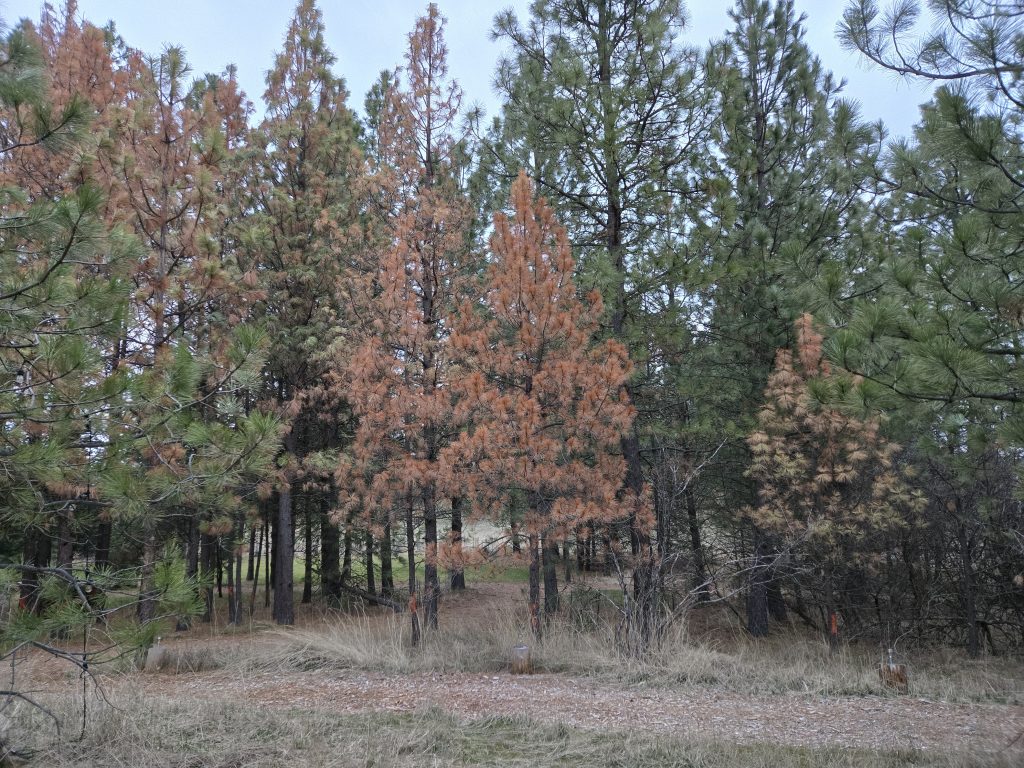
Tree Needles Turning Brown
The first indication of bark beetle infestation you will notice is the needles on an entire branch of a tree turning brown. Generally, the whole tree does not turn brown at once, but it starts in the middle or top and begins to spread (see the picture below as an example). Some Ponderosa needles regularly turn brown each year and fall off, so don’t be alarmed if your trees have a few brown needles. You should continue your investigation if you are unsure before making a final decision. Once you become more familiar with the issue, you will easily be able to identify whether the tree is being attacked.
Green Needles: Straight and Green or Drooped and Yellowing?
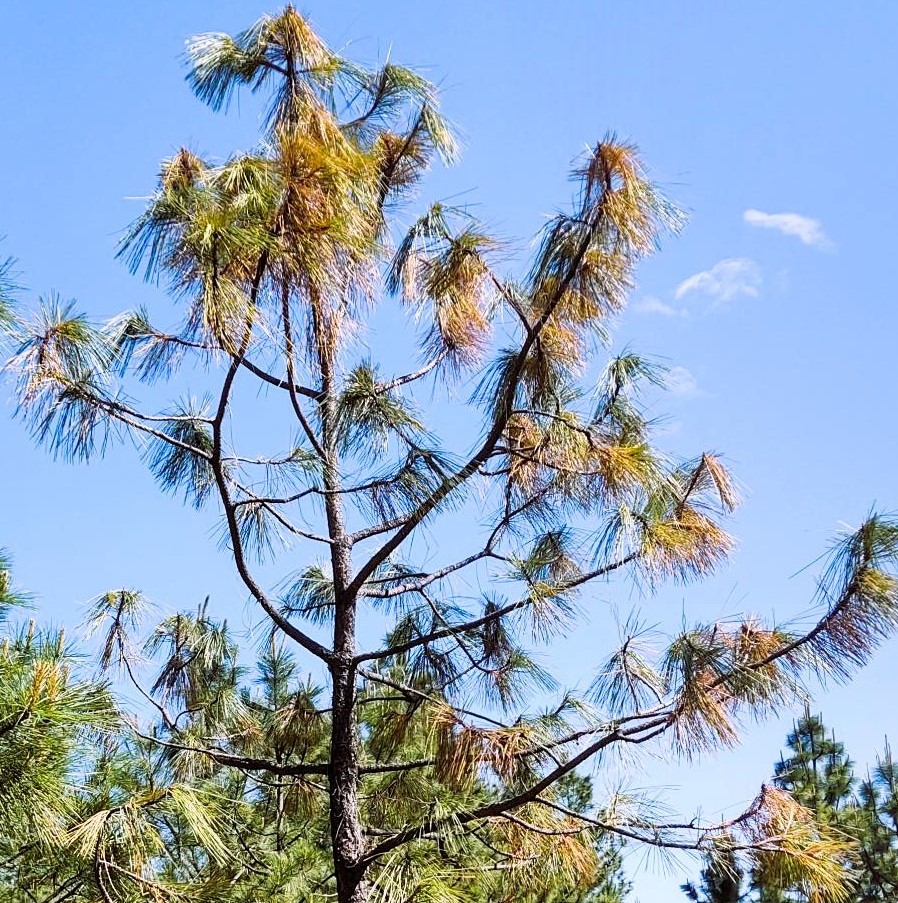
The next step in your investigation is to look at the green needles on the rest of the tree. Do those needles look green and straight or are they beginning to droop and look yellowish? Look at adjacent trees, are their needles all straight and green or are some of those trees looking yellowish and drooping? If there are a lot of green needles drooping, that is my key indicator that the tree has beetles.
Pitch Tubes in Bark: White or Reddish-Brown?
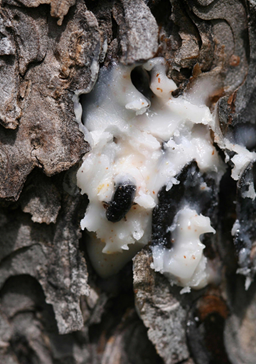
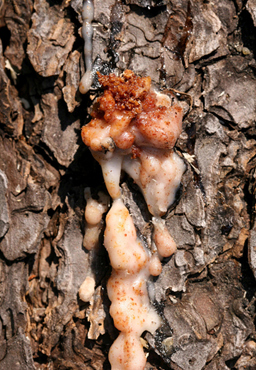
If you suspect the beetle is in the tree, look at the tree’s bark. Trees react to bark beetle attacks by releasing pitch as their natural defense. This response from the tree will leave small white or reddish-brown pitch tubes on the outside of the bark. A white pitch tube means the beetle was successfully repelled by the tree.
If the pitch tube is reddish brown, most likely the beetle was successful in attacking the tree. The pitch from a successful attack with likely be accompanied by a sawdust-like substance, called frass, created by bark beetles and their larvae as they bore through the bark. I haven’t seen the pitch tubes as much as the other indications of a beetle attack.
Holes in the Bark: Two Types
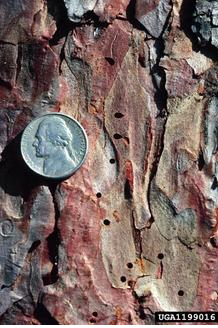
If you see tiny round holes in the bark as shown in the picture below, these are exit holes from beetles that have hatched in the tree and exited or from the adult beetle that has laid eggs and then exited to attack another tree. Just because there can still be larvae under the bark even though there are many exit holes in the tree.
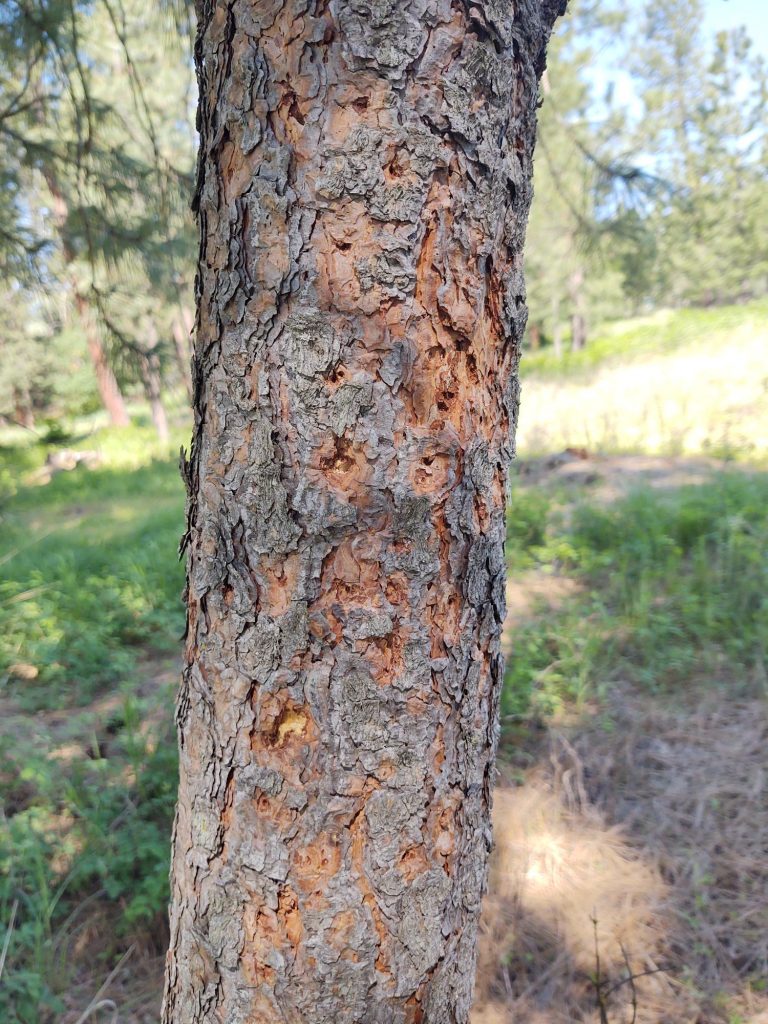
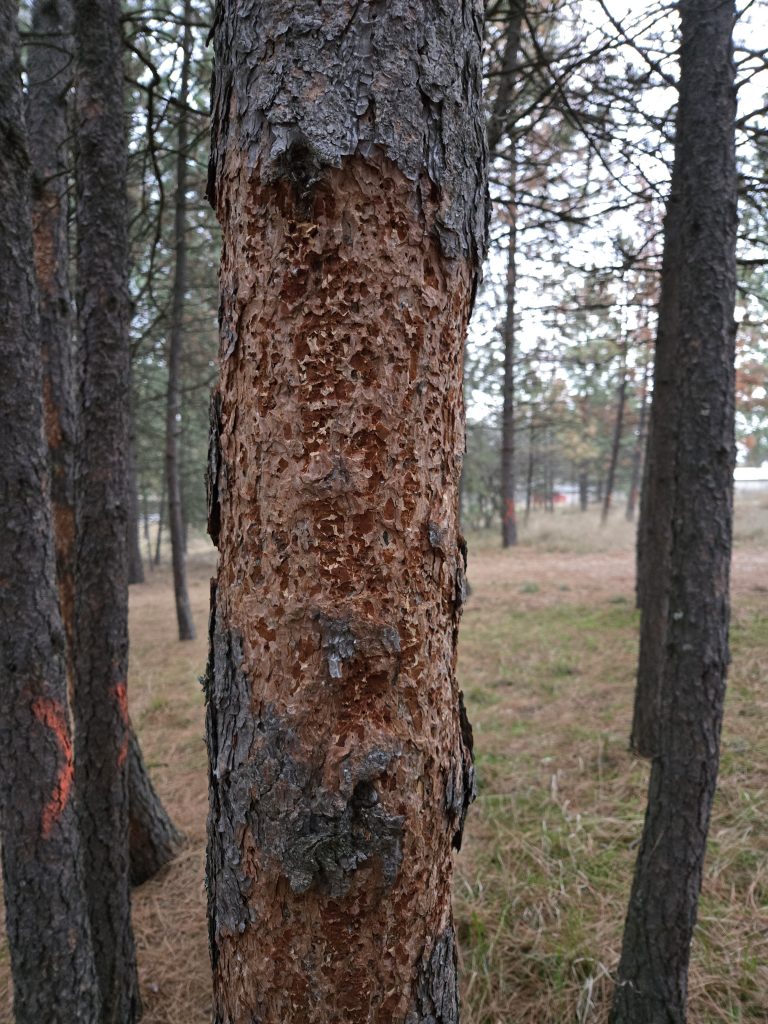
You may also see evidence of larger irregular shaped holes created as birds peck at the tree to eat the beetle larvae, as seen in the picture below.
Larvae and Channels Inside Bark
If you have all these signs, unfortunately, it’s not looking good. Finally, peel off a small section of the bark around the holes. It will probably come off easily if there are beetles or larvae behind it. If there was a beetle attack, you will see larvae and the channels where the larvae are feeding on the tree. (See picture below).
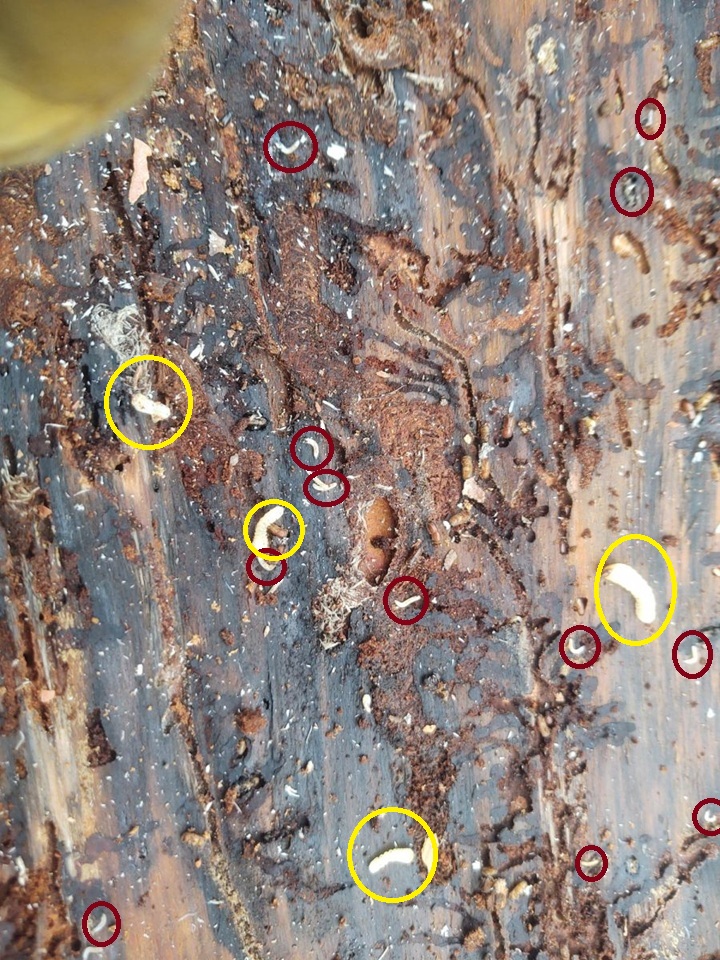
If this tree is not removed and the larvae destroyed, all these larvae will emerge as beetles to attack more trees. One tree can but full of hundreds of larvae.
Step 2: Removal of Beetle-Infested Trees
Timing is crucial for both removing
- If you discover bark beetles during May-September, the beetles are active and flying. Removing trees at this time can attract more beetles because the sap and chemicals produced by cutting the tree will draw more beetles to the area. However, the tree may be full of larvae that you could kill if you remove the tree. Remove some of the bark and see if the larvae are present or the beetles have hatched and flown. If the tree is still full of larvae, it may be worth removing the tree. If not, the tree is already dead or dying and it is probably better to wait to winter to remove the tree. If you cut the tree, you must chip and spread the chips at the time of cutting. The bark on the larger portion of the tree that can’t be chipped needs the bark removed or solarized.
- During the other times of the year, you should cut the trees, chip the branches, and destroy the larvae by burning, removing the bark, or solarization. See the next section for more information.
What to do with cut wood infected with bark beetle
Once you have cut down the tree, you’ll need to deal with the wood effectively to avoid further infestation.
What wood is infected?
- Signs of infected wood:
- If there are still some green needles on the tree, it is likely the larvae are still in the tree.
- If all the needles are brown and the bark on the tree is heavily pecked by birds, it is possible the larvae is gone.
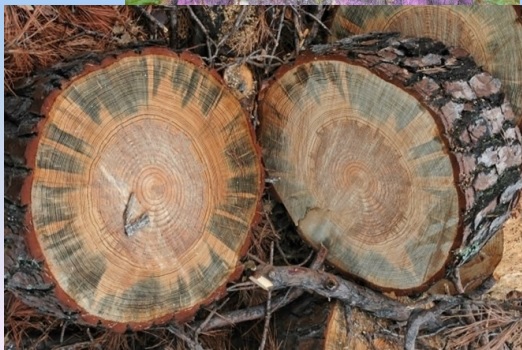
- After you cut the tree down, look for the blue stain on the wood as you cut it into sections. The beetles carry a fungus which dyes the wood blue in color. This is an indicator of where the beetle has attacked, or larvae is living in the tree. I cut 10 feet further than the stained area each way. I consider all of that wood as infected. I also look for signs of the beetle in portions of the tree that don’t have the stain, to ensure complete eradication. However, to be safe, you can consider all the wood in the tree as infected.
What to do if the wood is infected:
- Don’t give the wood away. This only spreads the problem to others.
- Don’t pile the wood and leave it. This just attracts more beetles.
- Chip the branches. Spread the chips so any remaining larvae will die.
Note: If using a commercial tree removal company, make sure they have a plan to not spread the beetles. Hopefully, they have a chipper large enough to chip the branches and the trunk.
How to kill bark beetles and larvae on cut wood you are unable to chip:
- Debark and destroy: Bark beetles feed on inner bark, so debarking logs will eliminate their food source. Destroy the infested bark by burning, landfilling, or chipping. This is the method I use on wood that is too large to chip.
OR
- Burn: Get a burn permit and burn the wood. You can get a permit from the Department of Natural Resources (DNR) to burn wood for this purpose
OR
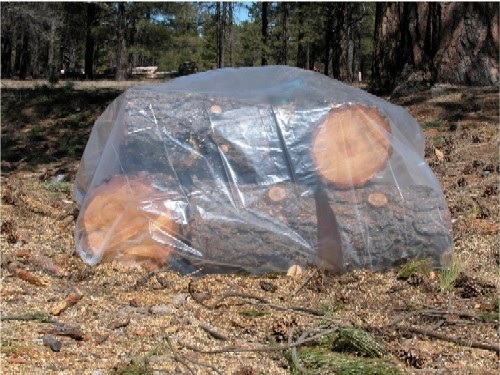
- Solarization Method: Cover the wood with a double layer of loosely-wrapped clear plastic. Soak the logs with water prior to covering with plastic, to promote mold growth and further deter beetle development. Stack wood two logs high, and place it in a location where it will get full sun. Seal the edges of the plastic in trenches covered with soil. The beetles cannot survive the heat under the plastic. You will need to keep the wood covered through the summer for the temperature to get high enough. See picture below.
Step 3: Remove unhealthily trees
Any tree with significant Dwarf Mistletoe parasitic plants growth or serious Western Gall Rust infection was removed. Dwarf mistletoes survive by robbing their host trees of food and water, which will ultimately lead to the host’s decline or death. Galls reduce growth and structural integrity; stem breakage is common in high-infection areas. Branch infections usually cause the branch to die.
Mistletoe and Gall Rust create stressed trees. The stressed tree emits fresh pine odors, sap, and alcohol-like volatiles that bark beetles find highly attractive. These signals can be detected from a distance, guiding beetles to potential hosts. Healthy pines produce a mix of volatile compounds, especially monoterpenes and other terpenes, which act as natural defenses. These compounds can repel or deter beetles. However, when a pine is stressed by disease or draught, it changes its chemical profile. The stressed tree emits fresh pine odors, sap, and alcohol-like volatiles that bark beetles find highly attractive. These signals can be detected from a distance, guiding beetles to potential hosts.
Weakened defenses make beetle attacks easier. Stress reduces the tree’s ability to produce large amounts of resin or sap in response to injury. Healthy pines can “bark up” by sealing wounds with resin, but stressed trees often cannot mount this defense quickly enough. This allows beetles to bore into the bark and feed on the phloem (inner bark) without being blocked.
By removing stressed trees, I hope to reduce the beetle attraction.
Step 4: Space trees to give the remaining ones less competition for moisture and more sunlight
Keep your forest healthy
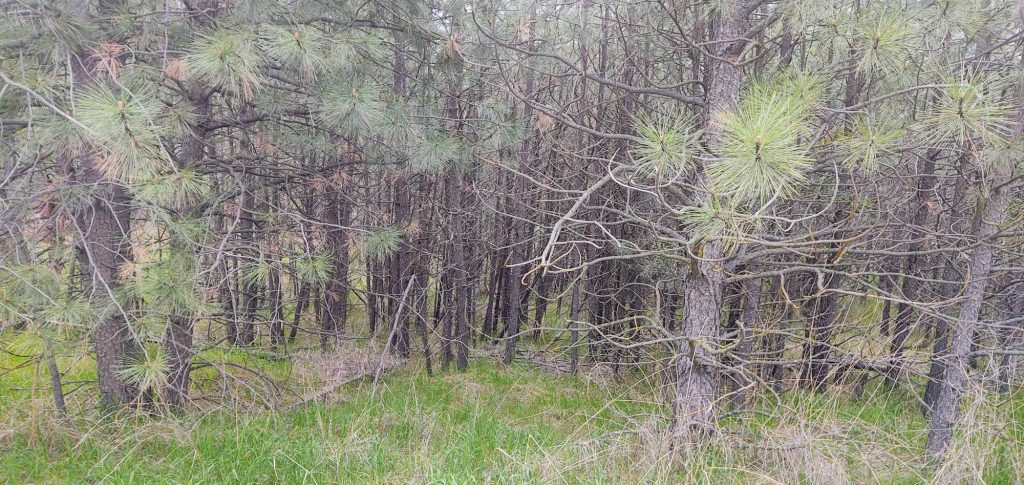
A healthy forest is the best prevention for pine bark beetles. Trees need water and sunlight to survive. Thin trees so they get sun and do not have to compete with other trees for water during the dry summer months. My rule of thumb for thinning is space trees so that they are greater than15 feet apart for small- to medium-sized trees. For trees greater than 50 feet tall, use 20 feet spacing. Another rule of thumb is to remove trees once the branches start touching the branches of other trees. The picture below shows an unhealthy forest where the trees are too close together.
Step 5: Spray high value trees with an insecticide in early May and late July
I use an insecticide called MAXXTHOR EC. You can find this insecticide at Bugspray.com. MAXXTHOR is highly repellent to the beetles and when applied to the bark of the tree will keep the beetles away for months. Even trace amounts will cause them to forage elsewhere. An added benefit is that helps control the mosquitoes and ticks. The active ingredient is Bifenthrin which is highly effective at killing insects, has low toxicity to mammals, and has good biodegradability. Originally, I sprayed once a year in May. However, after further research, I have learned that the Western Pine Beetle has two generators each year and has two periods they attack. Therefore, I plan to spray in early May for the first generation and end or July for the second generation.
Below is a list of the steps I use for spraying.
- Use a pump sprayer, hose sprayer, or motor-driven sprayer.
- Fill the sprayer with a mix of 1 oz insecticide per 10 gallons of water. Always read the directions for mixing and applying the spray. My mix rate may vary from the rate you decide is best for your application.
- Add a wetting agent (surfactant) to the spray mix to help it stick to the tree. A basic wetting agent is dish soap, or you can purchase surfactants at your gardening store.
- Spray the tree until it is dripping.
- Spray all sides of the tree.
- Spray to the top of the tree if you can reach it. I have a commercial sprayer that will reach 60 feet so I can get to the top of most trees.
An alternative to spraying is using pheromones to repel beetles
To prevent overcrowding of a tree, mountain pine beetles naturally release anti-aggregation pheromones to repel additional attacks from other beetles. The pheromone signals to other beetles that this tree is fully occupied, and to go find an unoccupied tree. These pheromones have been packaged and can be purchased as a repellent. The efficacy of pheromones is reduced when pine beetle population densities are already high. I have not found pheromone treatments to be effective, but other neighbors have had success when Verbenone SPLAT Verb Paste is applied to groups of trees in the spring.
Can a Tree With Bark Beetles Be Saved?
- Once the beetle has attacked a tree, it is very unlikely you can save the tree. The beetle eats its way around the inner bark of the tree destroying the tissue where the pitch and water flow to the crown. Also, the beetles carry with them the spores of blue-staining fungi. The fungi are introduced into the sapwood as the beetles excavate egg galleries under the bark. The fungi further aid the beetles by interrupting the nutrients from getting to the tree.
- If the attack is in the middle to the lower portion of the tree, the tree is likely gone and will need to be removed.
- If the attack is at the very top of the tree, you may have a chance. However, you will need to use a different treatment method and it’s important to note that it has worked on only trees where I have top-kill. Here is a link to a video https://youtu.be/OsbI8DT9lC0 that explains a root treatment to attack the beetles from within the tree. The root treatment is about 9:40 minutes into the video.
Below are links to useful information I have found to help manage the Bark Beetles.
- Bark Beetles in Ponderosa Pine
- Mountain Pine Beetle Fact Sheet
- Management Guide for Mountain Pine Beetle
- Western Pine Beetle Information
- Western Pine Beetle fact sheet (Idaho Dept of Lands)
- Bark Beetle Identification
- Pine Bark Beetle control and treatments for infected trees (bugspray.com)
See the post They’re coming for our trees