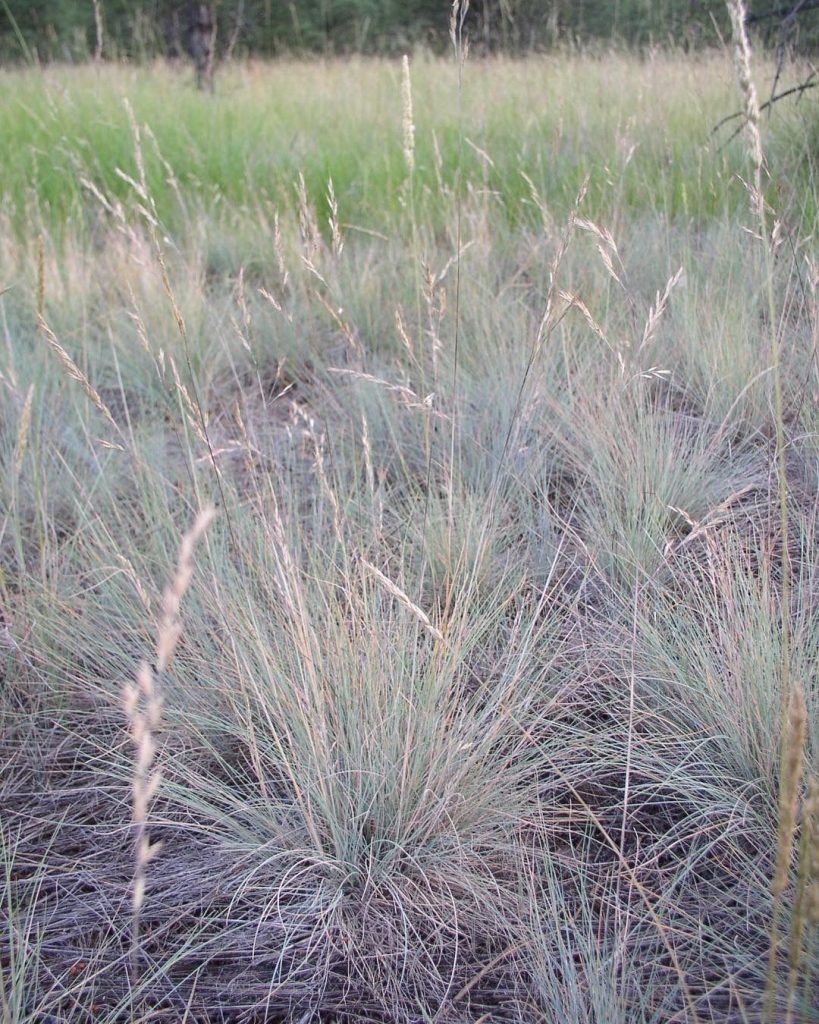
Grasses
Anytime you disturb the soil, weeds will emerge. Therefore, it is good to spread, and rake-in grass seed to the disturbed soil. Dryland grasses grow well in the Saltese area, but if you only have access to lawn grass seed, you can also use it. Any grass is better than weeds, so at least plant some type of grass.
If you want a seed mix better suited for the dry Saltese, below are my recommendations. Spokane gets an average of 17 inches of rain per year so search for a seed that can survive on 17 inches of water, or less. I have found Erosion Control or Reclamation mixes usually work best. I tend to avoid pasture mixes because the grasses need more water and grow taller which can increase fire danger in the later summer.
After years of researching and growing grasses in our area, I have created a custom grassland mix tailored for the drier areas of the Saltese. This mix features short- to mid-height grasses with a fine texture and an open, natural bunchgrass look. Its blend of blue-green and soft green shades gives it the feel of a dryland prairie rather than a typical lawn. It grows in a loose, airy pattern that’s perfect for the steppe landscapes of the Inland Northwest. The mature height ranges from 12 to 20 inches, depending on yearly rainfall.
Scott’s Super Duper Saltese Dryland Grass Mix
To create this mix you will have to order each seed separately and mix them yourself. The mix consists of the following:
- Annual Ryegrass 10%
- Streambank Wheatgrass 45%
- Idaho Fescue 30%
- Sandberg Bluegrass 15%
The reasoning behind this grass mix is as follows:
- Annual Ryegrass – This is the first grass you will see in about a week after planting. This grass has fast germination and establishment but is short lived. It will die in a year or two. The reason for this grass is for it to grow faster than the weeds, so it will compete with them for water and sun. The purpose is to choke-out the weeds before they establish. It is a cool season grass that grows well in spring and early summer and needs only 12 inches of rain a year. It is very inexpensive so don’t worry about it dying in a few years.
- Streambank Wheatgrass – Don’t be confused by the name. It doesn’t need to grow on a streambank. It is a common grass to the Great Plains and Intermountain Northwest. Unlike the other grasses this is a rhizomatous grass instead of a bunchgrass. Rhizomatous grasses form a sod where the bunchgrass grows in bunches. Depending on the location, one or the other is going to be favored, so I added both types to the mix. It is a cool season grass that needs a minimum of 8 inches of precipitation a year and it grows 12 to 18 inches high without irrigation and is great for erosion control.
- Idaho Fescue – This is a native grass to our area and is one of the most common grasses in the Western United States. It looks beautiful, is drought tolerant, resists cold, doesn’t grow too high, and competes well with the weeds. It takes several years to establish but it is worth it. It is a bunchgrass that grows in the spring, summer, and fall, depending on moisture. It grows between 1 to 2 feet high and survives on only 12 inches of precipitation a year. What more can you want from a grass in our area?
- Sandberg Bluegrass – This is the most common bluegrass in the Intermountain Northwest. It starts to grow in early spring and competes well with weeds. It is a bunchgrass that grows 8 to 14 inches high. It only needs 10 inches of precipitation per year, so it is drought tolerant.
All the grasses in my mix are palatable to wildlife but are not forage types of grasses. These grasses should be planted or raked in to a depth of 1/4 inches. I do a seeding rate of 1 lb/1000 sq ft. It is always good to keep grass seed wet for the first few weeks, so spring or late fall planting is best. I don’t typically water any of the grass I plant, I just rake it in and let it grow.
A lower cost alternative to Idaho Fescue is Hard Fescue. Both grasses are low maintenance bunchgrasses that are drought tolerant. Idaho Fescue is typically more expensive because it is a native restoration species where Hard Fescue is mass-produced for turf markets thus making it cheaper.
If you are also looking to create this seed mix, I order my grass seed from Great Basin Seeds in Ephraim, Utah.